Short answer: street dogs in Bali are mostly indifferent to you, temple monkeys are practised thieves, and rabies is present on the island. The practical rules for each are short, and the one that matters most is: any bite or scratch that breaks the skin gets washed immediately and assessed by a clinic the same day.
That last point is medical rather than a judgement call, and nothing on this page replaces seeing a doctor.
Last checked: 13 August 2026. This is practical information from living here, not medical advice.
Rabies — the part to take seriously
Rabies is present in Bali. It is carried mainly by dogs, and other mammals including monkeys and cats can transmit it. Vaccination programmes exist and the situation varies by area and over time.
What to do if bitten or scratched, in order:
- Wash the wound immediately with soap and running water, thoroughly, for several minutes. This matters and it is time-sensitive.
- Go to a clinic the same day. Not tomorrow, not "if it looks bad".
- Clinics in Bali deal with this routinely, and post-exposure treatment is available. A consultation is 200,000–500,000 IDR; the treatment itself costs more and is exactly what insurance is for.
- Tell them what animal, where, and whether it was provoked.
Pre-exposure vaccination is a conversation to have with a travel clinic before you come, particularly for long stays, riding daily, or spending time in rural areas. That decision is theirs and yours, not an article's.
Do not talk yourself out of going. The most common failure here is a small scratch from a monkey that someone decides is "nothing". See healthcare in Bali.
Street dogs
Bali has a large free-roaming dog population, including the indigenous Bali dog, a genuinely ancient breed. Most are owned or loosely community-owned rather than truly stray, and most will ignore you completely.
The practical rules:
- Do not approach or touch, however friendly one looks. This is the rule even for people who love dogs, and especially for children.
- Do not run past them on foot — it triggers a chase response.
- On a scooter, slow down. Dogs cross without looking and a swerve at speed is the actual risk here, more than the dog is.
- Be more careful at night, when packs are more common and more territorial.
- Compound and shop dogs are guarding something. Give them space rather than testing them.
- Do not feed them. It creates a following, and it creates a problem for whoever lives there.
If a dog is being aggressive: stop moving, do not make eye contact, turn side-on, and back away slowly. Do not scream or run.
Puppies and adoption: several genuine rescue and sterilisation organisations operate in Bali and do serious work. If you want to help, support one of those rather than taking a street puppy home on impulse — the export process for an animal is long, expensive and easy to underestimate.
Monkeys
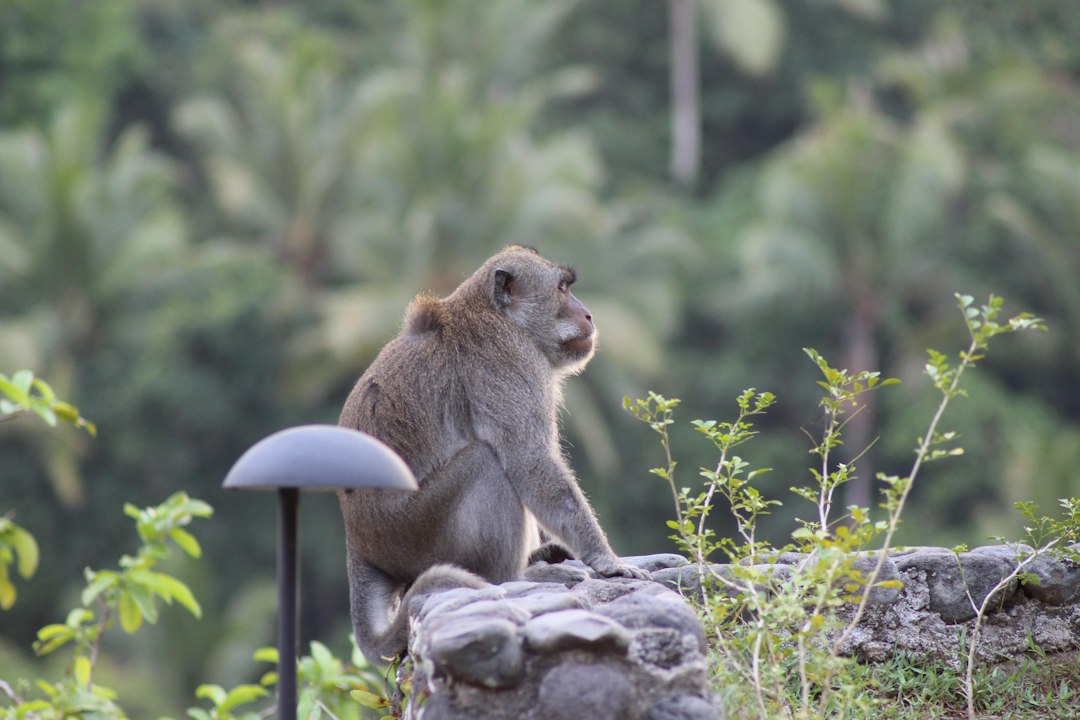
Long-tailed macaques, found at Ubud's Monkey Forest, Uluwatu temple and various roadside spots. They are wild animals living around humans, not an attraction, and the ones at the busy sites are extremely skilled at taking things.
The rules, and they are not optional:
- Nothing loose, nothing in your hands. No water bottle, no phone on a strap, no snack.
- Sunglasses off your head. That is the single most-taken item.
- Bags zipped and worn across the body. Plastic bags are read as food.
- No food, at all, including in a bag they can smell.
- Do not smile widely with teeth showing. In macaque body language that is a threat.
- Do not make direct eye contact or crouch to their level for a photo.
- Never try to take something back. Let it go. Staff at the main sites will often retrieve it; you should not.
- Uluwatu's monkeys are more practised than Ubud's. Zip everything away before you leave the car park.
See things to do in Ubud and things to do in Uluwatu.
The everyday animals
- Geckos — in every house, harmless, eat mosquitoes. The loud tokek call at night is a larger gecko and is a good thing to have around.
- Ants — relentless. Seal everything; open packets last hours, not days.
- Mosquitoes — the genuine health issue rather than the dogs. Dengue risk rises in wet season. Repellent, clear standing water around where you live, and get tested if you have a high fever for more than a day. See wet season in Bali.
- Snakes — present, mostly shy, occasionally venomous. Do not put hands into gaps in walls or long grass, and use a torch on unlit paths at night.
- Cows, chickens and dogs on the road — assume all three, particularly on village roads and at dawn. See scooter rental in Bali.
- Sea urchins — the most common marine injury. Hot water soak and removal; a clinic if a spine breaks off deep. See learning to surf in Bali.
- Reef sharks — present and not a practical concern for surfers or snorkellers here.
Animal attractions — what to skip
Stated plainly, because this is a category where a lot of visitor money goes to bad practice:
- Anything involving riding, holding or posing with wild animals. Elephants, big cats, civets, snakes, orangutans.
- Luwak coffee plantations with caged civets — common, overpriced, and poor welfare. See Bali coffee guide.
- Roadside photo props using bound, chained or visibly sedated animals.
- Any "sanctuary" that lets you handle the animals. Legitimate rescue and conservation work looks nothing like that — the animals are kept at a distance, the focus is release or lifetime care, and there is nothing to pose with.
Genuine conservation exists in Bali — turtle hatcheries, coral restoration at Pemuteran, the Bali starling programme in West Bali National Park, and serious dog rescue and sterilisation organisations. They are worth supporting and they do not offer a photo with a sedated animal.
Practical setup
- Insurance that covers animal bites and post-exposure treatment. Check rather than assume.
- Know where your nearest clinic is in week one, before you need it. See arriving in Bali.
- Soap and clean water access — the first-response step for any bite.
- Repellent, and clear standing water where you live.
- A torch for unlit paths at night.
- Do not feed anything, anywhere. It is the root cause of most human-animal friction here.
The honest perspective
Animals are not among the top risks of a Bali stay. The order, honestly, is: scooter accidents by a wide margin, then infected cuts and stomach bugs, then mosquito-borne illness, and only then animal encounters.
But rabies is the one thing on that list where a small, easily dismissed injury can become extremely serious, and where the correct response is simple and immediate. That is why it leads this page rather than the monkeys.
Where the money leaks
Nothing animal-specific — but the pattern that runs through this whole site applies to the clinic visit too: local clinics charge 200,000–500,000 IDR for a consultation, while a hotel doctor or a resort-arranged visit costs several times that for the same care.
And everywhere else: villas 40–60% cheaper monthly than nightly, gym and studio weekly passes 30–50% below drop-ins, spa slots in the empty 1–4pm window at 30–50% off.
Last Call Bali tracks what venues across Canggu, Pererenan, Ubud, Seminyak, Uluwatu and Sanur are discounting right now, with a direct WhatsApp line to the venue. No commission, no booking fee, no card details.
See what's discounted near you today →
Related
- Healthcare in Bali for nomads
- Bali temple etiquette
- Things to do in Ubud · Uluwatu
- Wet season in Bali — dengue and mosquitoes
- Scooter rental in Bali
- Arriving in Bali: your first 48 hours
How this page is verified
Practical guidance comes from long-term residents, clinic staff and what people here actually do, cross-checked rather than drawn from a single account, and re-verified quarterly.
On rabies we deliberately give a procedure rather than a risk assessment. The prevalence varies by area and over time, vaccination programmes change the picture, and no article can tell you whether a specific animal was infected. What does not change is the correct response — wash thoroughly, go to a clinic the same day — so that is what this page states. Nothing here is medical advice; speak to a travel clinic before you come and to a doctor here if anything breaks the skin.