Short answer: a warung plate in Ubud is 30,000–50,000 IDR and a café main is 90,000–180,000 — the same two-economy split as the coast, except Ubud's cheap end is better. This is the best place in Bali to eat actual Balinese food, and the one place where vegan eating is cheap rather than a premium.
Last checked: 12 August 2026. Prices in Indonesian rupiah.
What things cost
| Meal | Warung | Café | Restaurant / fine dining |
|---|---|---|---|
| Breakfast | 20,000–35,000 | 65,000–110,000 | 120,000–200,000 |
| Lunch | 30,000–50,000 | 90,000–150,000 | 150,000–300,000 |
| Dinner | 30,000–55,000 | 90,000–180,000 | 250,000–700,000 |
| Coffee | 15,000–25,000 | 30,000–55,000 | 50,000–80,000 |
| Fresh juice / young coconut | 15,000–30,000 | 40,000–70,000 | 60,000–90,000 |
| Large local beer | 25,000–40,000 | 45,000–70,000 | 70,000–130,000 |
Ubud is marginally cheaper than Canggu at the warung tier and roughly the same at the café tier. Where it differs is the top: Ubud has genuinely world-class restaurants in the Sayan valley, and those bills go higher than anything in Canggu.
The geography of price
This is the single most useful thing to know about eating in Ubud.
| Where | Character | Price level |
|---|---|---|
| Jalan Raya / around the palace | Highest footfall, most tourists | Highest |
| Monkey Forest Road | Broad range, busy | Mid–high |
| Jalan Goutama | Narrow lane, no traffic, small restaurants and bars | Mid — the sweet spot |
| Side streets off the centre | Family warungs | Lowest |
| Penestanan / Nyuh Kuning | Where long-stay residents eat | Low–mid |
| Sayan / Kedewatan | Valley-view restaurants | Highest, worth it once |
The Jalan Goutama rule: if you want to walk somewhere and eat well without paying palace-adjacent prices, that lane is the answer almost every time.
What to order — Ubud specifically
Ubud is the best place in Bali for Balinese food, as distinct from generic Indonesian.
| Dish | What it is | Price |
|---|---|---|
| Babi guling | Balinese roast suckling pig with crackling, spiced vegetables | 45,000–80,000 |
| Bebek betutu | Duck slow-cooked in spice paste and banana leaf | 80,000–150,000 |
| Ayam betutu | The chicken version, more common | 45,000–75,000 |
| Nasi ayam kedewatan | Spiced chicken, rice, sambal — an Ubud-road classic | ~40,000 |
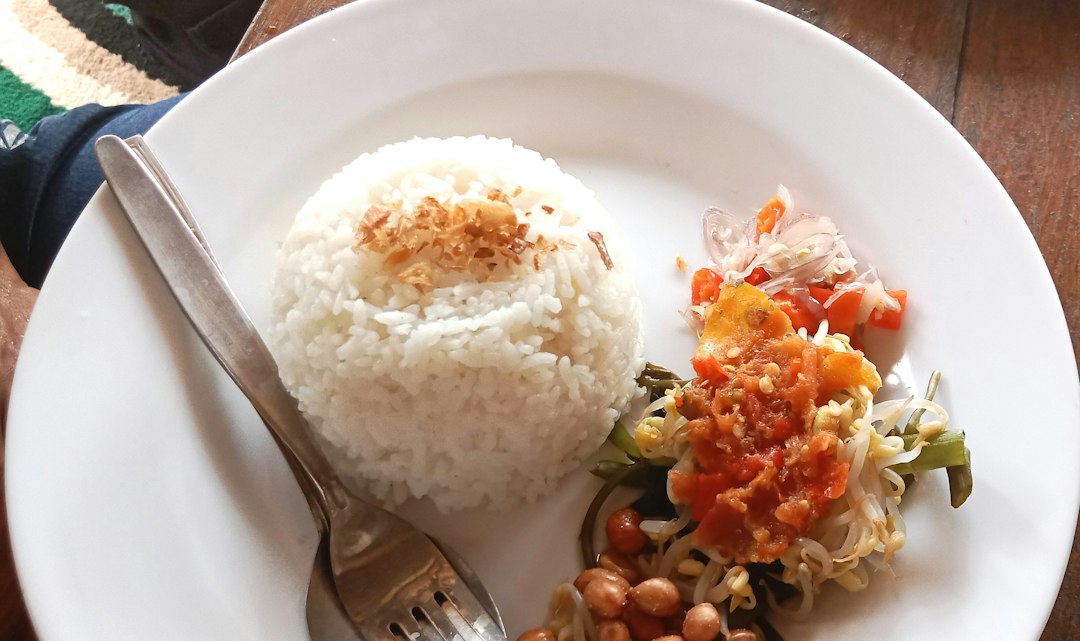
| Nasi campur | Mixed rice, the default plate | 30,000–50,000 |
| Lawar | Minced meat, coconut, herbs — genuinely local, ceremonial roots | 25,000–50,000 |
| Sate lilit | Minced fish or chicken satay on lemongrass | 30,000–60,000 |
| Gado-gado / pecel | Vegetables, egg, peanut sauce | 25,000–40,000 |
| Tempeh dishes | Fermented soy, a local staple | 20,000–45,000 |
| Kopi tubruk / es teh | Local coffee / iced tea | 5,000–15,000 |
Warung Ibu Oka is the babi guling institution — go at 11am, they sell out. That pattern holds for most of the good ones.
Why vegan food is cheap here
Ubud has a reputation as expensive plant-based territory, and half of that is true — the smoothie-bowl-and-raw-cacao tier is genuinely pricey.
But tempeh and tofu are local staple proteins in Bali, not health-food substitutes. A warung plate of rice, tempeh, vegetables and sambal is 30,000–40,000 IDR and happens to be vegan without anyone marketing it that way. Ubud is the only place in Bali where you can eat plant-based every day for warung money.
The one thing to ask: terasi (shrimp paste) and fish sauce are used widely, including in dishes that look vegetarian — including many sambals. "Tanpa terasi" means without shrimp paste and is understood everywhere.
The market
Pasar Ubud — the main market — is produce on the ground floor, handicrafts above. Before 9am it is a working local market; after that it shifts toward souvenirs. Weekly fruit and vegetables for one person costs 150,000–300,000 IDR.
Local produce is cheap. Imported anything — cheese, cereal, olive oil, wine — is 2–3× European prices, and wine carries heavy import duty (an ordinary bottle is 350,000–600,000 IDR while a large beer is 30,000).
A realistic weekly food budget
| Pattern | Weekly IDR | Monthly IDR |
|---|---|---|
| Warungs only | 550,000–850,000 | 2,400,000–3,700,000 |
| Mixed — warung lunch, café dinner | 1,000,000–1,600,000 | 4,300,000–6,900,000 |
| Cafés and restaurants | 1,600,000–2,200,000 | 6,900,000–9,500,000 |
The practical middle: warung breakfast and lunch, dinner wherever you feel like. That saves 3–4 million IDR a month over café-defaulting, with no real loss.
Good for / skip if
Eat mostly at warungs if: you are here a month or more, you want to actually eat Balinese food, or you are on a budget. Ubud rewards this more than any other area in Bali.
Do not force it if: you have complex dietary requirements beyond plant-based, you need a laptop-friendly table with aircon, or you are here four days and the difference is not the point.
The honest negatives
- Everything closes early. Warungs sell out by 2pm; much of town is done by 9–10pm. Coming from Canggu this catches people out constantly.
- Central traffic and parking are genuinely bad, and some streets restrict Gojek and Grab pickups.
- The famous places have queues and sell out. Go early or go elsewhere.
- Tourist pricing on Jalan Raya is real — the same dish can be 60% more within 200 metres.
- Hidden shrimp paste in "vegetarian" dishes. Ask.
- Delivery maths is bad at the low end: a 35,000 IDR warung plate delivered lands near 55,000–70,000 all-in. Ride out for cheap food; deliver the expensive food.
Where the money leaks
Food is the second-biggest line in an Ubud month after rent, and the leak is defaulting to the visible tier on the main road. But the unadvertised-discount pattern runs through eating out here too: early-dinner sets, quiet-weeknight food promotions, and the 3–6pm drinks window that closes earlier than the coast's.
Ubud's biggest unadvertised discount is not food at all — it is the empty 1–4pm spa slot at 30–50% off the evening price, and yoga multi-class passes that cut roughly a third off the drop-in.
Last Call Bali tracks what Ubud venues are discounting right now — food promotions, happy hours, spa slots, day passes — with a direct WhatsApp line to the venue. No commission, no booking fee, no card details, and the venue keeps 100% of what you spend.
See what's discounted in Ubud today →
Related
- Cheap eats in Canggu — the coastal comparison
- Things to do in Ubud
- Working from Ubud: cafés and coworking
- Happy hour in Ubud
- Cost of living in Bali — three monthly budgets
How this page is verified
Price bands come from eating at these tiers and cross-checking against what current residents report, re-checked monthly. We deliberately avoid publishing a fixed list of named warungs — the good ones sell out, change hands and get discovered, and a stale list of names is worse than a method for finding them. What holds is the price structure, the dish vocabulary and the geography of where the price line sits.